breaking / briseadh / wa'aidom
Breaking / Briseadh / Wa’aidom
Laura Ní Fhlaibhín and Tyler Eash
Britta Rettberg, Munich, DE
16 May – 27 June 2026
Questions on Breaking: a conversation with Laura Ní Fhlaibhín and Tyler Eash
Tyler Eash: A lot of Indigenous Peoples believe that our worldviews live in our languages. I understand the English made speaking the Irish language a punishable offence, and that there were a lot of parallels of histories of violent assimilation Boarding Schools in both our cultures. Can you tell me what the Irish language means to you and how it informs your sense of identity and world view? How does it feel to reclaim your language?
Laura Ní Fhlaibhín: When I was applying for my first passport as a 17 year old, I made the decision to use the Irish form of my name. It felt intuitive and thrilling, an act of reclamation. Up until then my name was in the anglicised form, as is the case for so many others on the island. The Irish language was nearly erased but not quite during the colonial oppression, it was banned throughout the judicial courts, and only English was allowed in the education system that became formalised in the mid 18th century., it was against the law to use Irish or teach Irish as a teacher or student. A lot of historians are of the opinion that the heaviest blow for the language was the famine years and aftermath, in direct and indirect ways; the language of administration of any meagre and inconsistent food relief and famine works was exclusively English. Speaking in the mother tongue was equated with the denial of food, what cruelty. The population of Ireland fell by 20-25% during the famine years, one million died, one million emigrated. All those lost speakers, it’s heartbreaking. And then the traumatised aftermath and fragmentation of society, all of the breaks and ruptures that came from the famine, which was exacerbated by non-existent British government responses. It felt good, last year, with the introduction of a long campaigned for repeal, The Identity and Language Act in The North. Nearly three hundred years later, another penal law overturned overruled,which made it "a criminal offence to use any language other than English" in court. Tá ár lá ag teacht.
Laura Ní Fhlaibhín: Following on from this, can you talk a bit about your ancestors and kins’ experience of famine? An aspect of the colonisation of Ireland, was the weaponisation of food. I can see that my preoccupation with materials that offer nourishment, such as the salt licks in this project, reflect on this instrumentalisation...
Tyler Eash: We have a very specific relationship to our land and we are still fighting to repair ancestral food systems as a component of that relationship. However there were many generations where this knowledge was safeguarded in very few and often undercover and dispossessed Maidu hands. I now recognise that the wildflowers I grew up picking as a child in our woods are our wild vegetables. I can see “Soap Root” growing alongside the road and know that it can be cooked as a vegetable, used to wash my hair, that it will stun fish, cure poison oak rashes and that I can even paint with its bristles. However I needed access to a Maidu elder to know that one plant can allow me survive detached from colonial agricultural systems. Because our land was full of gold, our treaties weren’t ratified. They didn’t set aside land for us for our food cultures to be protected. They wanted all of our land, our gold, and our bodies for forced labour. We were called digger Indians because we dug the gold, but also because on contact they saw us digging (and cultivating) root vegetables in the “wild”. Although sometimes I wonder if this is because anthropologists only saw us post-contact and hungry, struggling, cut off from fishing and hunting after settlers quickly destroyed California.
Laura Ní Fhlaibhín: Can you talk of the historic significance of weaving within your community?
Tyler Eash: I was asked to weave and sing by an elder of mine. It’s considered a feminine art form, but it’s also the primary art form of Indigenous Californians. As a queer Native, as a 2Spirit, it’s something I’d like to pursue, but also I have to state it’s a dedicated craft. I look to other Maidu like Stephen “Makat’i” Young, to weaving. They know where all the ancestral plants grow, they are tending those relationships with elders. I myself travel, I’m out telling our story internationally, that we’re alive (and pissed). I will find contemporary materials on the go that I’ll weave, as a way of making sense of the world, binding together elements, but it’s different. It’s only loosely rooted in this ancestral practice of making relatives from your environment. Makat’i inspires me, and I’m grateful for their acts of cultural renewal, but I think my task is to try to open our practice of weaving to a conceptual discourse of world-building. I’ll state in our origin story, our world came from a bird’s nest dropped into a landless ocean. That primordial basket was then stretched and pulled by Coyote and EarthMaker to be the world we live in today. There’s a lot to extrapolate with basket making and I’m just on the surface of these ideas now. But I like that a basket is an environment held together by an intentional interaction with the environment. That makes sense to me. That feels connected to a culturally informed philosophy of ethics that I protect as a Maidu 2Spirit.
Laura Ní Fhlaibhín: I’m interested in learning about indigenous historic approaches to the cultivation and care of land, I read somewhere how fire is/was seen as a medicine for the land, what are your thoughts?
We use fire to steward the land. All across Turtle Island (and within Australia) First Peoples would use fire to clear our dead wood, to thin out small trees and brush, and ultimately create a healthier ecosystem that allows the forest to be lived in by a diverse collective of animals (that includes man). These regular burnings would also prevent devastating and uncontrollable forest fires. There are many Native plant species that can only germinate after fire, like manzanita (a food source). There are also plants like bear grass that require fire for new growth to allow us material for baskets. Fire is necessary for our ecology and our ecology includes Indigenous Peoples. Fire is a part of the “American” landscape but was prevented because Europeans did not possess this knowledge enough to be an authority. This is funny because European settlers stole Native land because settlers said Natives didn’t know how to “use” it. The fires that spread across California recently were inevitable, and reveal how clueless settlers are to living with stolen land. Whilst it’s sad that Jamie Lee Curtis lost her mansion in LA, my heart breaks more for Greenville (where so many Maidu live) that was lost in the Dixie Fire. I saw endless Maidu mountains burned and the diverse people who lived in them, covered in ash and camping in their cars in the Walmart parking lot without a financial safety net. That’s America!!! It’s so frustrating for people to have the ancestral knowledge to know how to tend to their own land and to be denied the seriousness or authority to enact that wisdom in practice. The fires of California should be a revelation to Non-Native Californians, that we First Peoples need access to our lands so others themselves don’t suffer from their own ignorance. It’s sad to me that it had to reach that degree of destruction but it’s completely a consequence of settler-government anti-Indigeneity. They kicked us out, put up fences and created “the wild”. By making “nature reserves” the woods nearly died due to being cut off from Man/Maidu. There is no such thing as “the wild” that’s a colonial fantasy. Every “wilderness” has civilisation. WE ARE NATURE.
Tyler Eash: How do we as living artists repair our ancestral cultures whilst remaining contemporary?
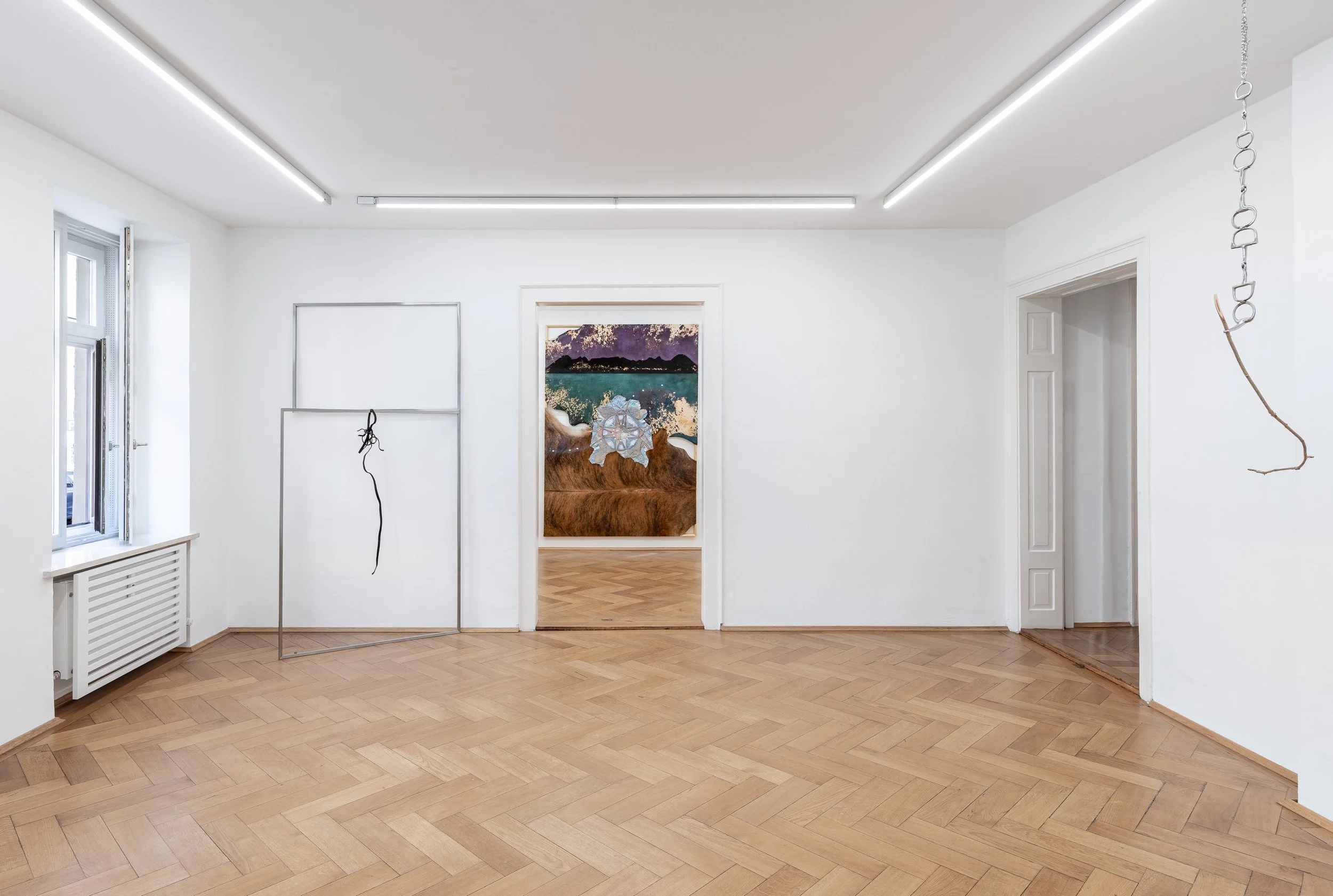
Laura Ní Fhlaibhín: For me, in my practice, there is a lot of embodied, embedded care, often towards ghosts. My grandad was very tuned in to the presence of ghosts, living alongside ghosts and spirits, as his ancestors. He grew up in east Galway, on a small subsistence farm adjacent to the sites of Ireland's bloodiest battle, the Battle of Aughrim. He and his siblings would always walk the long way home, for fear of disturbing the ghosts. There’s an Irish expression, translated as the thin place-a porous place, where the spirit and human worlds overlap and mingle, and my granddad grew up in one such seeping place. I guess I view my kin ancestors-both human and of other species- as lively, agential ghosts and I attempt to show allyship, support them through intervention, sometimes sculptural. In this show, Ghost rail is made with ghost horses in mind, thinking of those that have supported vulnerable humans, those that have been indentured, those that have been cannon fodder in colonial assaults; it gestures towards an opening, a way out, and a recognition, to be seen, heard, understood. Same goes for the drawings; they are made with salt blocks-a nutrient supplement for horses- the drawings can nourish the horse, in previous iterations I have drawn on the museum walls using the salt; imagining if ghost horses came by, they could lick the walls and be replenished.
Laura Ní Fhlaibhín: I am thinking around points of connection with the plantations of Ireland which resulted in the widespread mass destruction of ancient Oak forest in Ireland -oaks from a forest near my childhood home were shipped to London to function as the beams of Westminster-can you talk a bit about the violence of land grabs in California?
Tyler Eash: Its safe to state that Indigenous Californians are the most underrepresented regional group of Native Nations in Turtle Island/North America. That’s because the U.S. funded California Genocide/California Gold Rush was 90% extermination in 30 years 1850-1870. After America’s most severe genocide, the capture of young women and children, sexual assault, displacement, and centuries of slavery (1769-1937) was used to cut us off from the land beneath our feet. We were not allowed to return home to where we already lived. We were to be consumed by conquest enough to disappear, through intimidation, assimilation, violence. We’re still waking up from generations of fear. I hold the door open for relatives who are still waking to who they are, and who might be living in the street. But the intimidations of settlers trying to keep us in hiding still very much exists. Our sacred land, having so much gold deposits and having such a idyllic climate and fertile alluvial soil for agriculture meant environmental destruction and genocide were synonymous acts of colonial violence. How could we fish our salmon if our river banks were being gutted with giant jets of water into banks and hillsides; mining our mountains for gold? How could we harvest acorns if our oak trees were felled for fire wood or to become lavish Victorian houses funded by said stolen gold? Our deer, our antelope, our non-human families were either killed off or ran deep into the mountains away from us. We can’t live when our land is dying. Our Earth worshipping cultures become erased. This is why Native artists are asked to speak to environmentalism, but our issue is with real empires that still exist and aren’t held accountable. There are still monuments to heroes who we call monsters. It’s the German born Johann Sutter who found the gold and initiated our slavery in the Gold Fields. There is still a statue of him in Basel, the epicentre of the contemporary art world. How am I supposed to feel about that? Land is the basis of all wealth. The vast majority of land in the Americas is stolen, which means the majority of American wealth is stolen. That’s simply an unarguable fact that should result in reparations, but truthfully these crimes are unforgivable. Much of the environmental destruction of my homelands of the California “Gold Fields” can be traced to East Coast businessmen as well as California’s first founding “leaders”. For instance Wells Fargo Bank itself funded our extermination by selling bonds. You know, there’s real people and families and businesses that benefit from these crimes. It’s not a mysterious tragedy simply because justice was not yet served. I personally feel I have a very real and justifiable right to take issue with the greed of humanity as a Maidu person. The world’s love of money (gold) is the basis of our genocide. I think of this now, knowing that Basel Switzerland celebrates the legacy of John Sutter (our slaver) with a statue, with poetry, and films and theatre. I think of how maybe perhaps one day they’d be interested in removing that monument and telling our story instead of his legacy. Maybe one day they’d help us tell the world that we still exist. That way the world would stop with their indian extinction fantasies. Maybe some day soon, we could get John Sutter’s name off our sacred mountain. Maybe people could help us get our sacred “Peace Valley” back, the epicenter of the original religion of Northern California. That’s a start and it’s so easy, but these settlers, they think we’re too far gone now, that we are “past-tense”. They think we don’t exist anymore so they can live guilt free. That’s why I’m making a spectacle of myself across the globe, to prove we are still here. I’m trying to open a door to reparations and land returns to people who were subject to legal slavery until 1937 under the Act for the Government and the Protection of Indians. A history most Californians don’t even know.
Laura Ní Fhlaibhín: How has the trauma of occupation created stories of survival or a sense of pride in your culture?
Tyler Eash: We are known as the region that suffered such extreme extermination that we are often spoken of as tombstones of America’s genocide. However, we see ourselves as survivors. Maidu share in the responsibility of being the caretakers of the legacy of “Ishi” (Last of the Yahi), who was called the “Last Real Indian” internationally. He’s called as such, not because he was the last of us (as he has living relatives) but because he was the last Native to evade capture/assimilation/slavery. Ishi is famous for being the last to remain in the “Old Ways”, away from the plantations and mines, hiding from violent settlers. Though later he was ultimately captured and was a living exhibit at the University of California in San Francisco. The California Language Archive gifted me recordings of Ishi singing in captivity. This was because some of these songs are in Maidu, because he is related and tied to Maidu, as we are all tied to each other in culture and kinship in this region. That’s why I push hard against how Ishi has become a symbol of the extinction of our region, and how our region has become used as fodder for a global Indian extinction fantasy. I’m blessed to have grown up and still live in Ishi’s woods, 10 minutes uphill from where he revealed himself. However, I don’t claim a figure that’s been granted a form of sainthood. I’d rather say that he’s made the lands we live on that much more sacred. But it’s still a battle for our visibility, even other Natives sometimes use Ishi’s story to erase us because they think our region is blank. It harms our case for reparations for slavery, for land returns and truth-telling. Really, we are survivors, that’s what Ishi symbolises. My community are proof that Natives of Turtle Island will always be here, that we can’t go extinct no matter what we might look like. We aren’t going to disappear or forfeit our land and identity to empire.
Tyler Eash: Given the timeline of Anglo-colonialism, I’ve often heard that the occupation of the Irish became a sick experiment that later informed tactics of anti-indigeneity and cultural destruction globally. The Choctaw Nation even gifted money to the Irish during the “Famine”, noting solidarity due to a common enemy in the English and the uncontrollable settler empire of “America” that they started. Given that the Irish still are under occupation, how do the Irish view occupied peoples of the world? I also ask as someone who descends from people who were displaced from Northern Ireland.
Laura Ní Fhlaibhín: With a deep sense of solidarity. Although Ireland/Irishness/‘The Irish’ has many conflicting voices, resulting in a messy, polyvocal sprawl. As much as I hope that we (as ‘The Irish’) all align, I cannot un-see Irish flags hoisted as brazen symbols of far-right allegiance just this last month. Or in a field on the outskirts of my hometown, plastic manure coverings arranged to spell out a hostile message to those newly-arrived and seeking refuge in this green land. In ALL CAPS.
Tyler Eash: We both have made a lot of work about horses, and your works speak to a lot of extant symbols of control and dominance through European horse culture. Do you see the act of “breaking” a horse as a parallel to colonial violence and oppression enacted on Indigenous Peoples and the working class globally? Conversely the horse is often depicted as a symbol of freedom, yet it becomes a source of labour; ie “horse power”. What does the symbol of a horse mean to you in regards to our exhibition?
Laura Ní Fhlaibhín: My work in this show and over the last six or so years is predominantly centered on the horse-human relationship and bond, and it’s autobiographical. My cousin Roisin has received much care and support in equine therapy sessions, at a centre for young people with moderate to severe intellectual disabilities. I have observed her and her therapy horse, and been stunned by the steadiness and patience, the awareness of vulnerabilities, from the horse to their human. I understand and can see the weight and labour for the horse as care-worker in the equine-therapeutic relationship dynamic. It got me thinking of indentured horses in historic contexts, through colonial era Ireland and within the military complex more broadly. The German Army alone lost approximately 2.7 million horses during the second world war. The Ghost Rail work in our show was made with the window dimensions of the Irish Museum of Modern Art in mind; the museum first existed as a British military barracks. I was thinking of the indentured horses, all the lost horses, and the gesture of ‘opening the stable door’ - the steel structure is open, the horse can run, imagining, willing the ghost horse to leap, soar, gallop over and out of the complex. I enjoy that here in Munich the gallery window closest to the rail is left open a wee bit, willing the ghost horses escape. A new series of works for this show-charred horse reins, twisted into carbon forms- Briste agus imithe ar nós na gaoithe-( broken and gone as fast as the wind) speaks to control, colonial dominance, indentured labour, and the gesture of burning this apparatus to carbon, resolutely rendering its intended function obsolete. These new forms speak to me of language, of ciphers, of code, perhaps somehow landing back at an utterance.
Tyler Eash: Given that the majority of Irish people of the world transitioned from occupied/Indigenous to displaced/diasporic to “white” settler, what message would you have for all the diaspora who see this unknown and distant part of themselves as “white”. I ask in a time where Indigenous peoples are combating white supremacy as a lasting residue of European Empire. What would you also tell to all the Indigenous peoples of Anglo colonies like Australia, Canada, Aotearoa, and Turtle Island/USA/Canada, who might have some ancestors from Ireland, and who are asked to reconnect to all of their ancestral origins to feel whole?
Laura Ní Fhlaibhín: I would say céad míle fáilte.
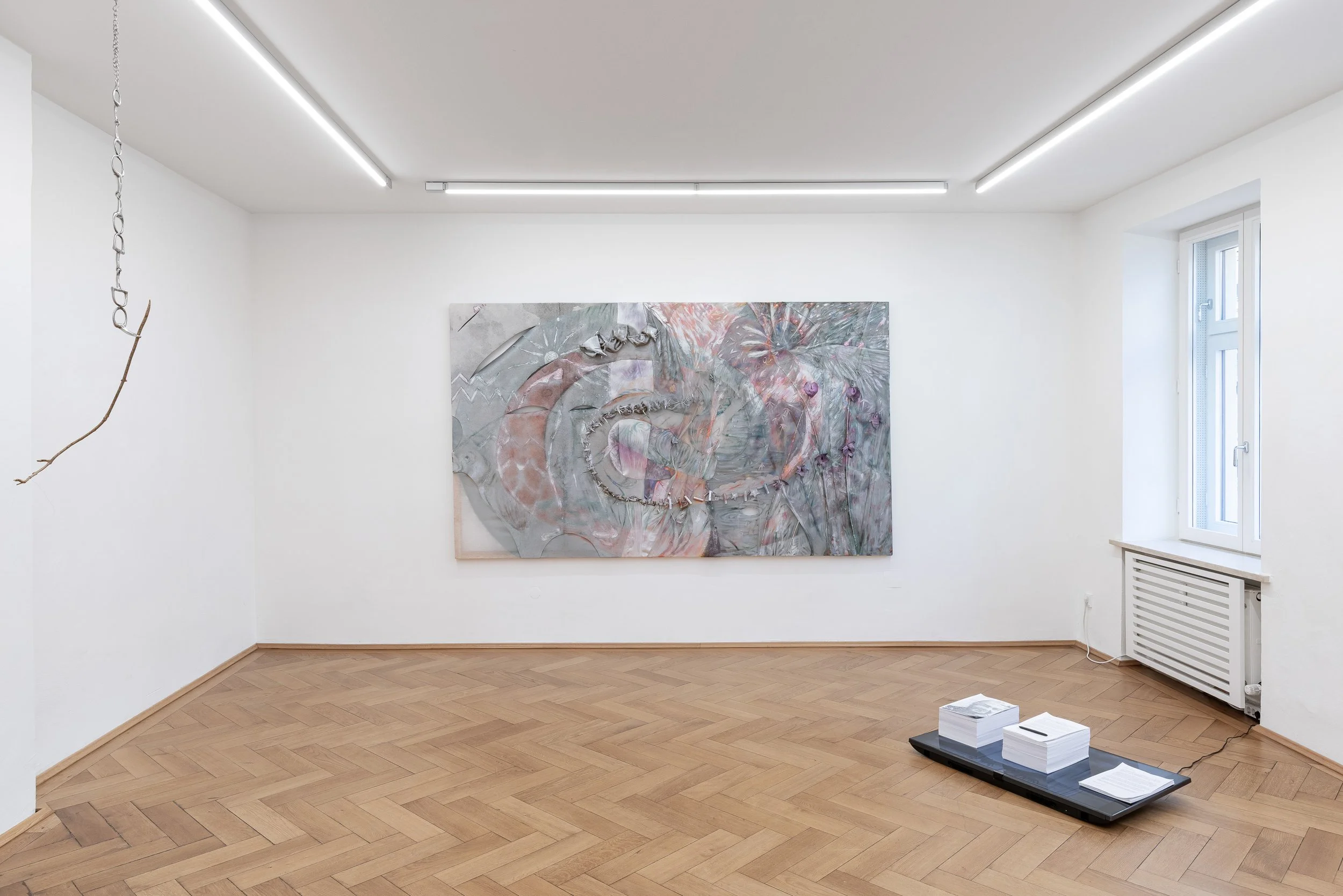
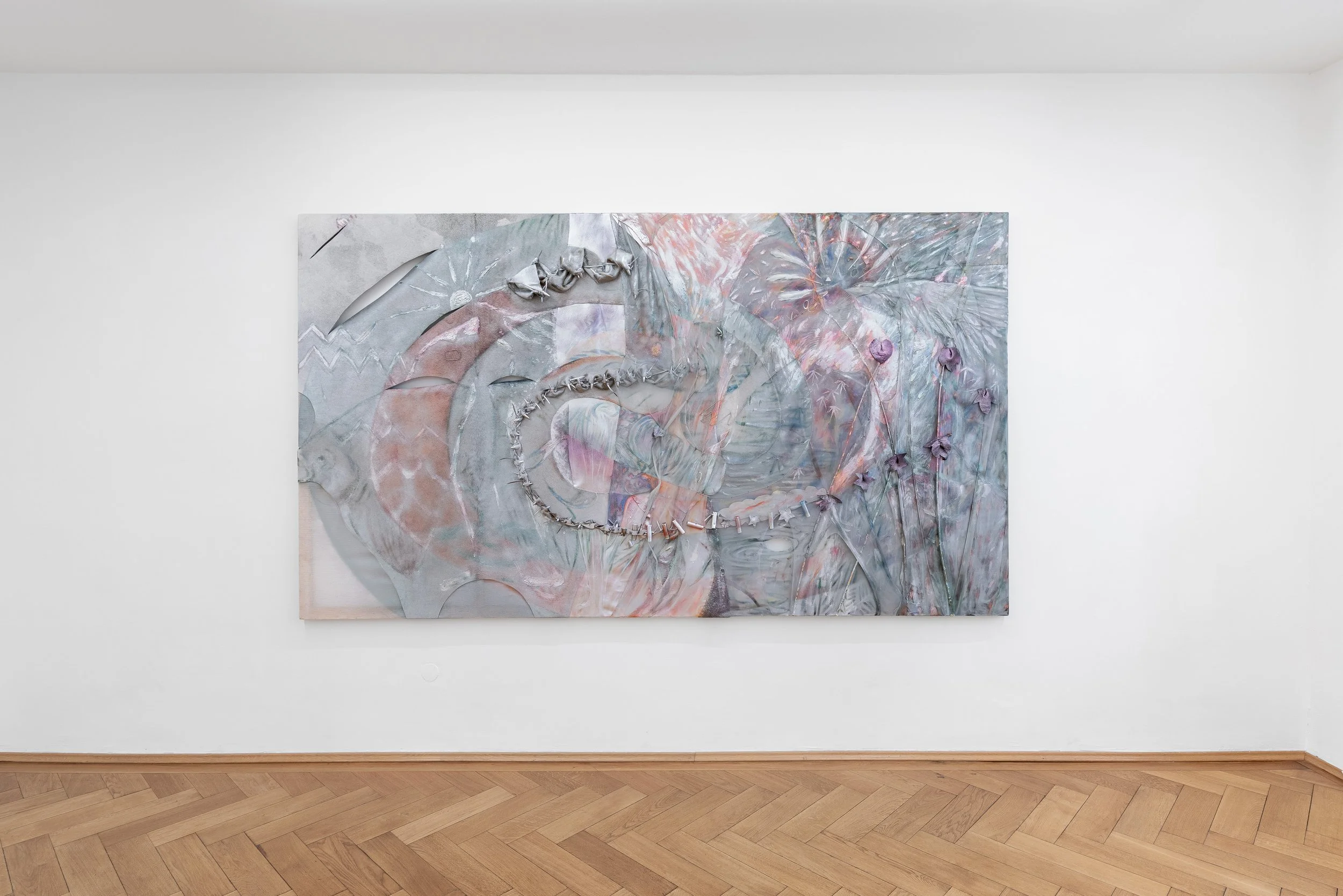
Sànodim / Behind the Fire, Tyler Eash, 2025
oil, pigment, acrylic, colour flip car paint on cow hide, gauze, willow, artist’s jacket, lambskin, found feathers, Burberry buffalo horn toggles, abalone beads, digger pine nut seed, dentalium, mirror, steel ball bead chain, 170 x 300 cm
Sànodim / Behind the Fire is a hand-stitched multimedia painting that uses various Indigenous materials; including beadwork, feather-work, and the use of animal horn and hide. The work is layered with found materials such as Burberry buffalo horn toggles and shotgun shells, leathers, and fabrics. Images such as petroglyphs and faces of ancestors are interwoven with a scene of the artists’ river consumed in fire, and all morphed into a counter-clockwise spiral (the direction of earth-worshipping dances). The various medias are painted over with oil paint, chrome and colour-flip automotive paint. The work is auto- biographical, referencing Eash’s dual Indigenous Californian and European- Settler identity, where in “Behind the Fire” is a direct translation of the Maidu word “Sànodim”. In this definition, fire is a sacred and ancestral entity capable of bringing forward change and answers to prayers. However, the title plays on the phrase, in reference to always existing behind enemy lines.
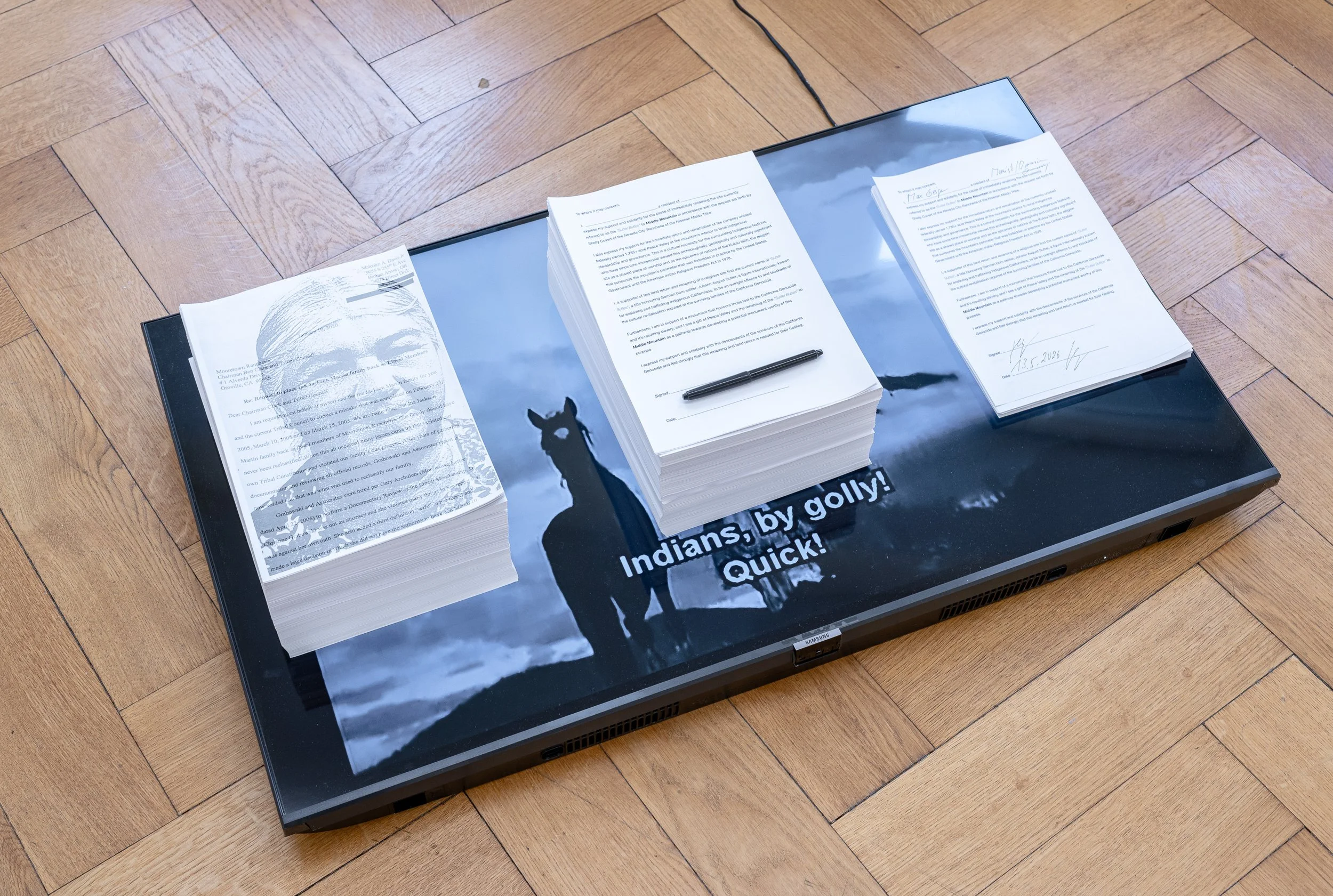
Nicht der Kaiser von Kalifornien, Tyler Eash, 2026
LCD screen, found film, lenticular sheets, printed letters, and pamphlets on A4 paper
Nicht Der Kaiser von Kalifornien is a multimedia interactive assemblage work that considers both the erasure and visibility of peoples Indigenous to the “Gold Fields” of California. The film’s protagonist, German born “John Sutter”, initiated the world’s fastest movement of human migration and the most severe violence in North America due to his discovery and announcement of gold in unceded Nisenan Maidu homelands. The film celebrates the legacy of a man who initiated the California Gold Rush/Genocide to pay his debts to Switzerland, however the film erases his impact on the Maidu, whom he trafficked into slavery. The work takes the German made historical film “Der Kaiser von Kalifornien” (the king of California) as a point of departure to highlight the Maidu’s fight for visibility after generations of genocide, sexual assault, slavery and assimilation. Whilst the audio of “Der Kaiser von Kalifornien” plays through the exhibition from a lcd screen on the gallery floor, stacks of pamphlets concerning an ongoing disenrolment case of a Maidu woman who has a face identical to the artist’s mother. are exchanged for signed letters of solidarity with Indigenous Californian’s call for the return of “Peace Valley” and the renaming of a sacred mountain from “Sutter Buttes” to “Middle Mountain”. With this work, an audience chooses if they can assist a people who are actively being erased. “Nicht der Kaiser von Kalifornien” is a real act of diplomacy. The work will travel and aims to be restaged in Los Angeles, California, displaying the signed letters of unlikely allies from Sutter’s home country.
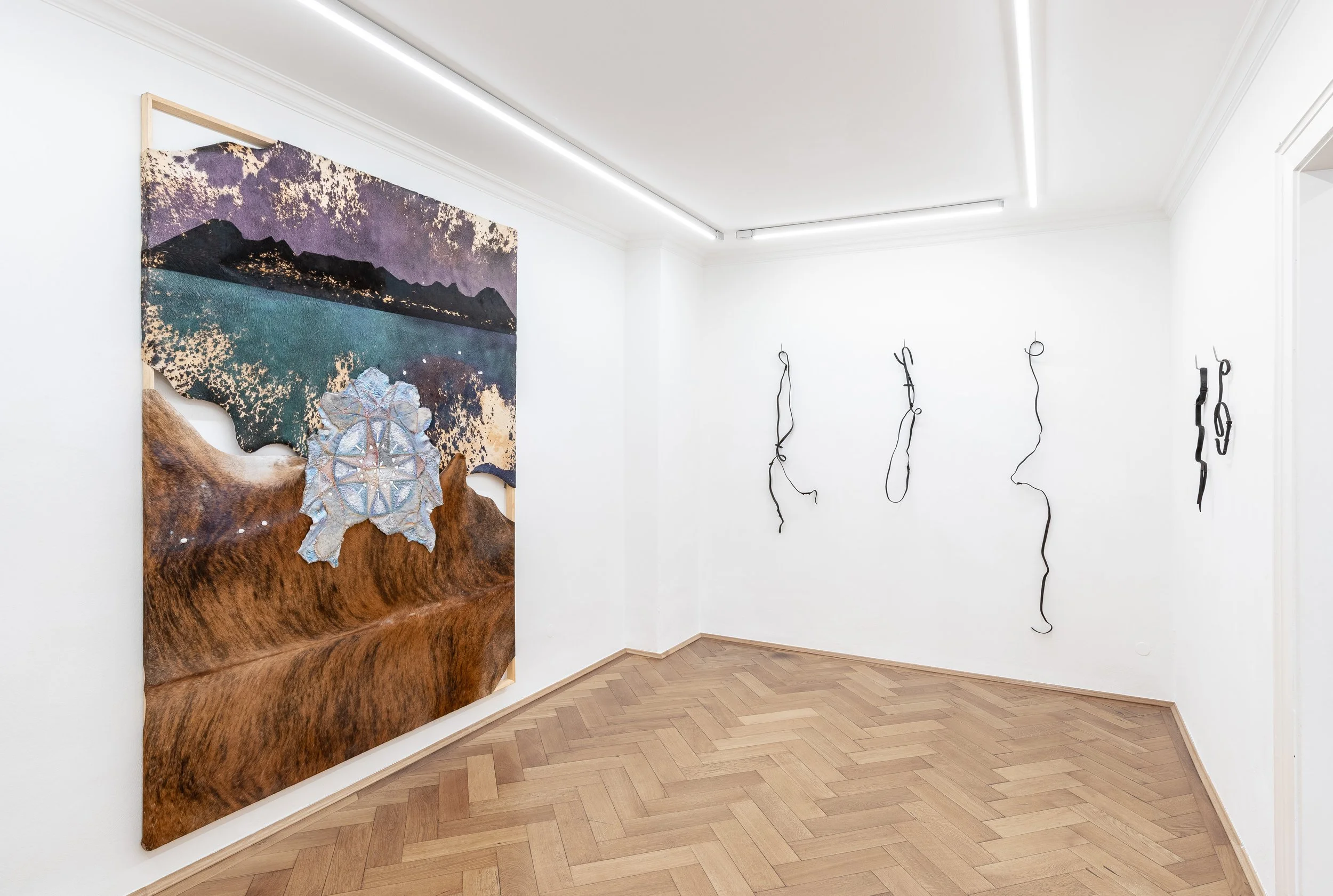
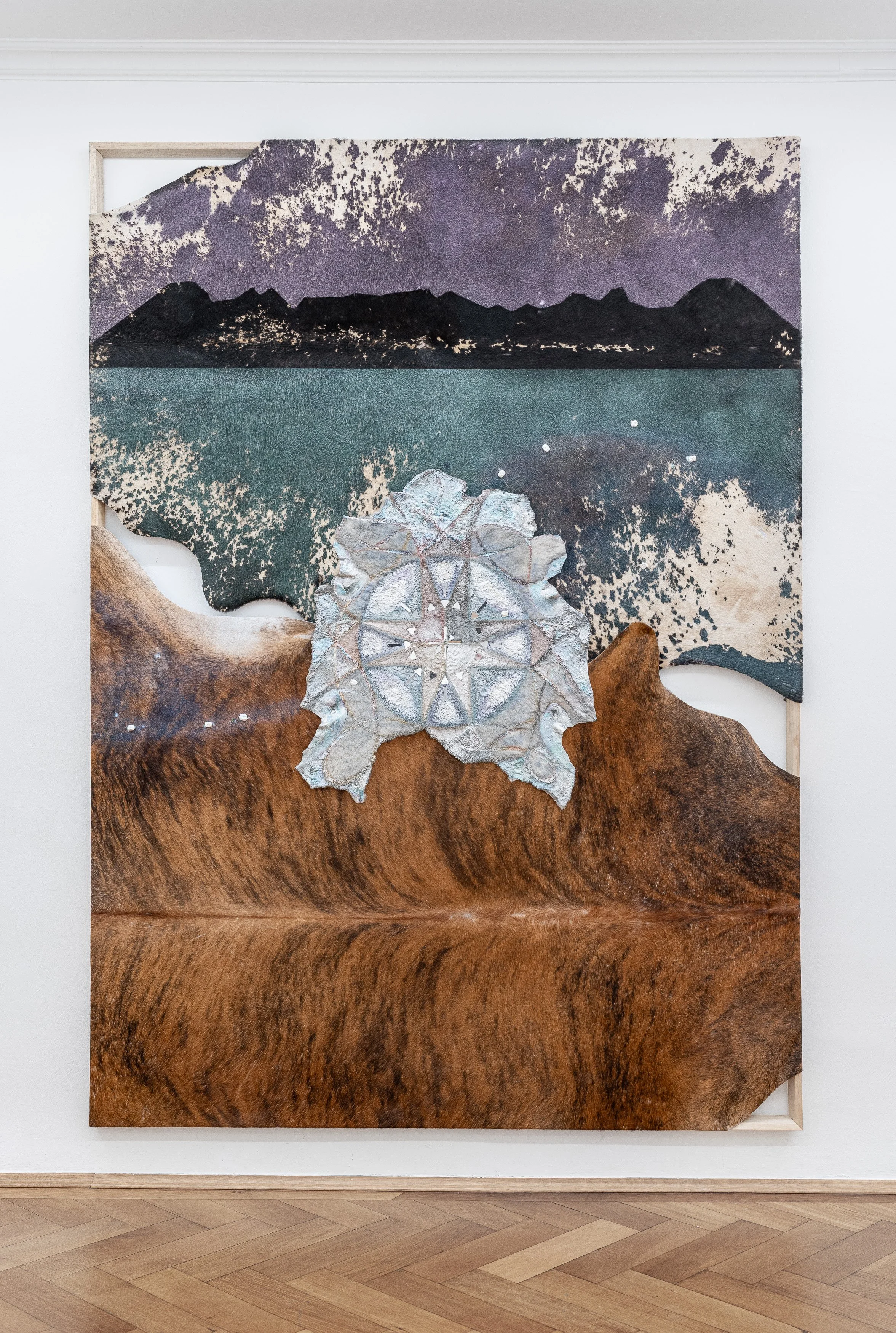
Histum Yani / Middle Mountain, Tyler Eash, 2025
colour flip car paint, acrylic, oil and pigment on cow hide, calfskin, mirror, abalone beads, 251 x 180 x 4,5 cm
Histum Yani / Middle Mountain depicts a sacred mountain that is the centre of worship for people of the Kuksu faith, which is inclusive of various tribal nations of Northern California. Currently, the mountain is named after “John” Sutter, a German born settler who is credited for finding the gold that initiated the gold rush, but who made their fortune through stealing, enslaving, selling, and trafficking Indigenous Californians. Currently, there is an inter-tribal effort to change the name of the “Sutter Buttes” to “Middle Mountain”, a translation of its various indigenous names, that notes the place as a site of shared worship. There is also a campaign to return the 1700+ acre unused and fenced federally owned stolen land known as “Peace Valley” at the mountain's centre to shared Indigenous stewardship as a site of ceremony and worship. Through colour-flip aerosol car paint on cowhide, Middle Mountain is depicted in profile from the view of the artist’s childhood home; who’s family has lived in view of the mountain since time immemorial. It is also depicted symbolically in plan, as a spectre of oil, acrylic, and pigment on white calf skin. A medicine wheel is embellished with mirrored beads and keishi pearls at its centre.
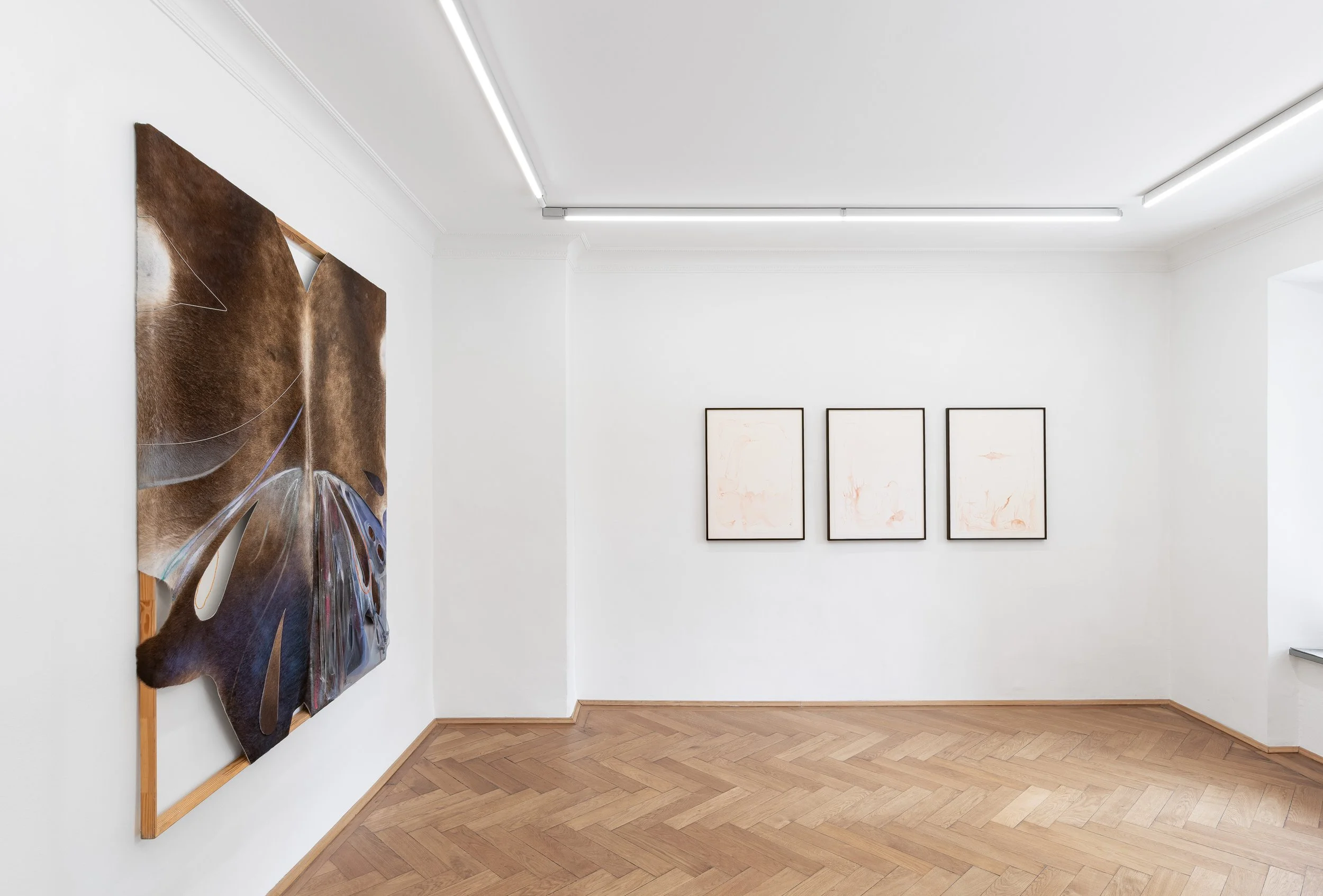
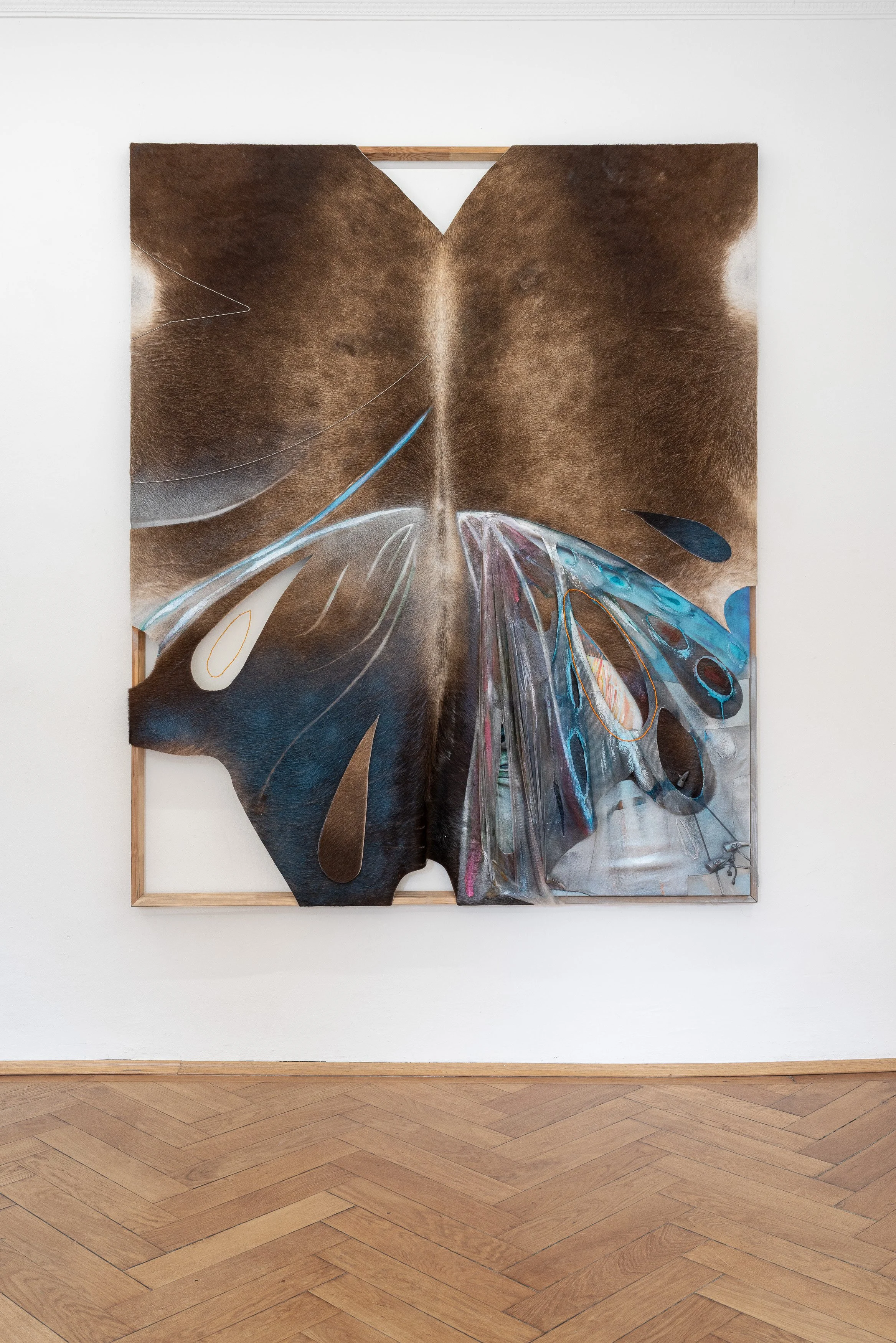
Kóh’bonom / Storm, Tyler Eash, 2025
colour flip car paint, acrylic, oil and pigment on cow hide, tulle, wood stretchers, mirror beads, steel ball bead chain, abalone beads, 200 x 165 x 8 cm
Kadíkim / Rain and Kóh’bonom / Storm depicts various butterflies emerging from a composition of stretched cowhide, leather, canvas, sheer fabric, broken mirror and beadwork. The title is the Maidu word for rain and storm. Here, the butterflies are bringers of rain to a forest fire, as painted in the stretched canvas inset within the abstracted wings. The work was made in response to the devastating “Dixie Fire” that destroyed significant forests in Maidu homelands, after First Peoples were forbidden from accessing and stewarding the land with “good fire” for generations. However, fire can be restorative. Fire brings renewal and rebirth. It is with the fires of California that the US Government has admitted ignorance over understanding the land, it is after these apocalyptic happenings that land returns have started to become more common. In Eash’s work, intuitively, butterflies have become a symbol of cultural renewal and revitalisation, a symbol of transformation after waking from forced assimilation.
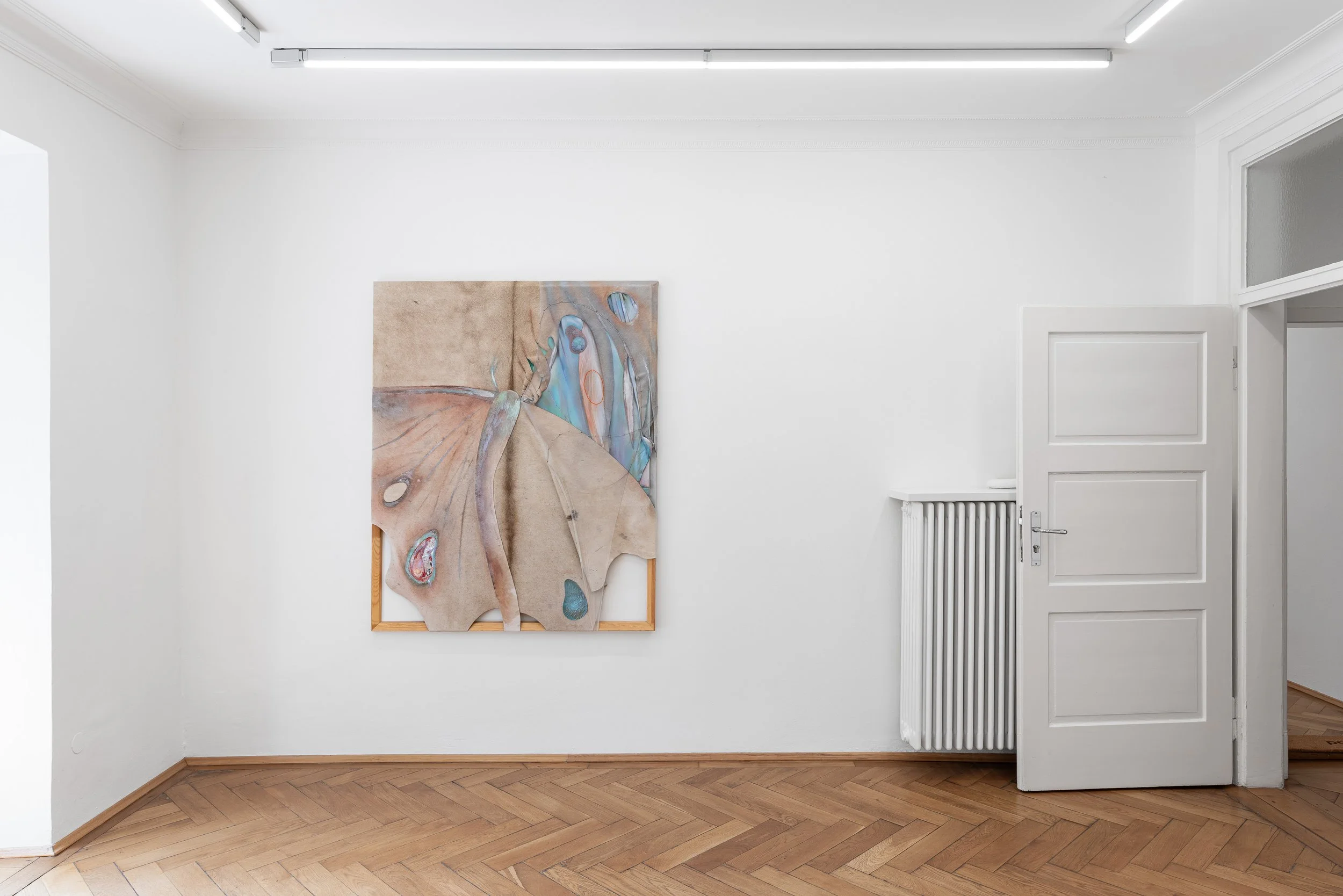
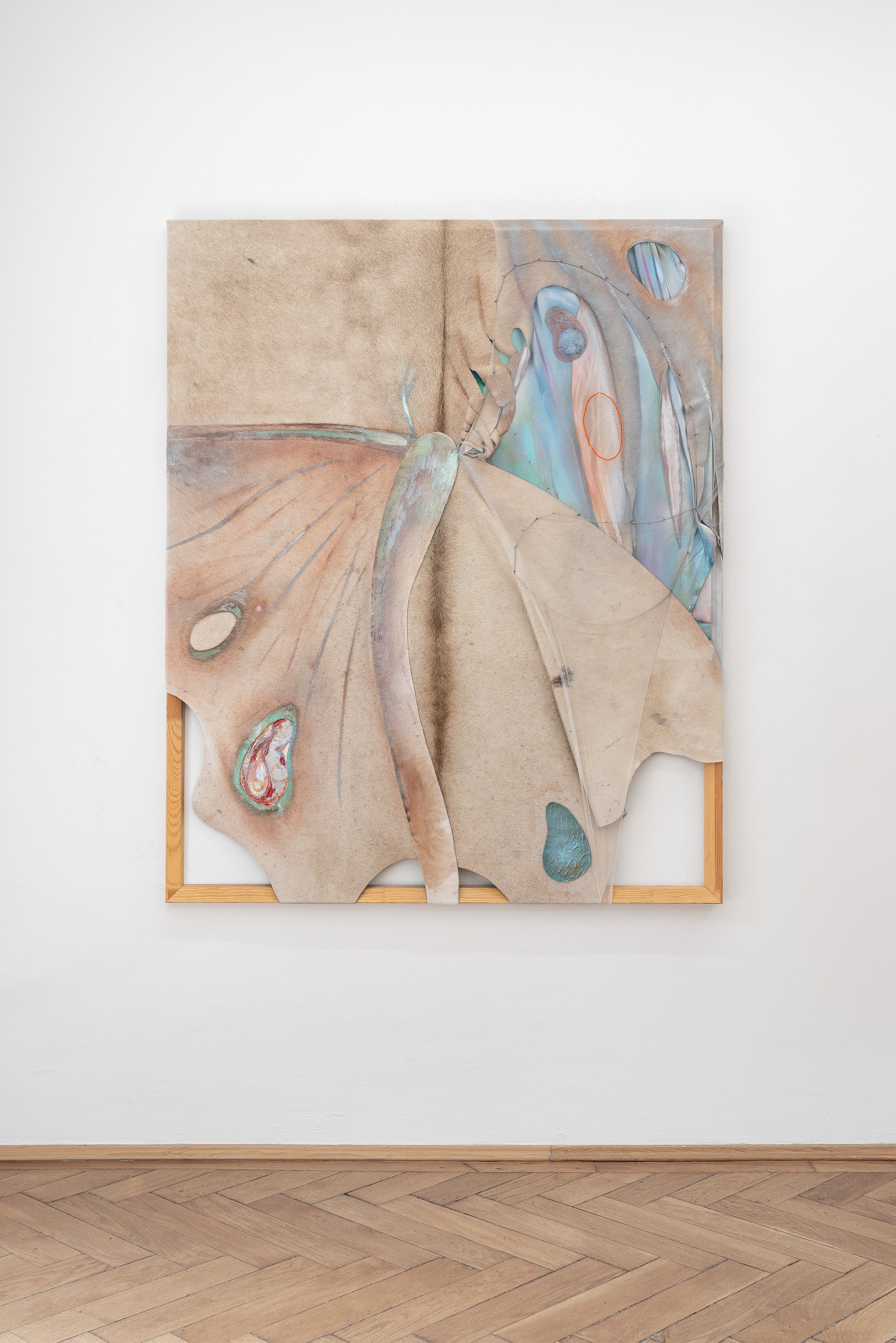
Kadíkim / Rain, Tyler Eash, 2025
oil, pigments, acrylic and colour flip car paint on cow hide, gauze, wood stretchers, canvas, glass seed bead, steel ball bead chain, lambskin, wing mirror, 160 x 130 x 6 cm